Traffic Calming
Keeping Ajax streets safe for all road users is a priority for the Town and using measures to “calm” the traffic is one way of achieving this goal.
Traffic calming is a term used to describe a combination of mostly physical features that are intended to reduce vehicle speeds, change driver behavior and improve safety conditions for everyone who uses the street.
The Town of Ajax uses a Council approved Traffic Calming Warrant process to evaluate all resident requests. This process sets out clear guidelines that must be met before traffic calming measures can be considered and implemented.
Traffic Calming Warrant
The Traffic Calming Warrant incorporates the latest best practices in traffic calming to address the variety of traffic inquiries relating to excessive speeding, traffic levels and collision frequency.
Examples of Traffic Calming
There are many methods of calming traffic. Some of the most common types of traffic calming measures are:
- Lane Narrowing
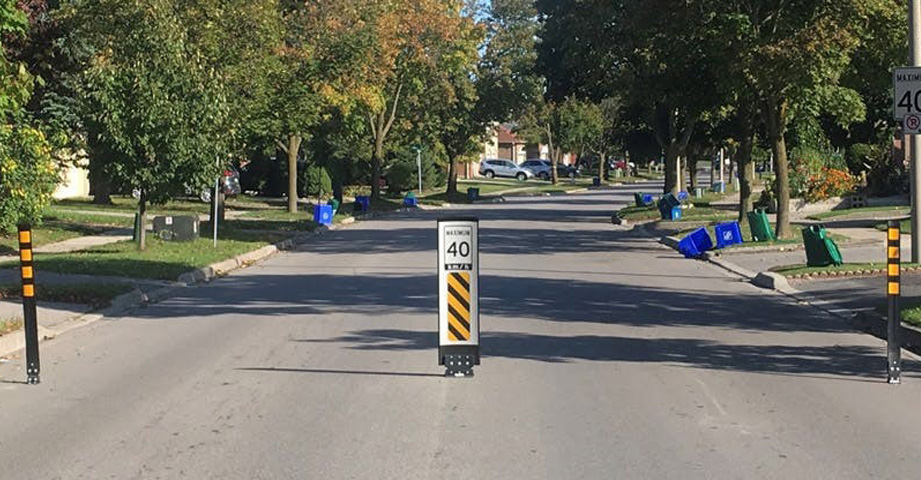
- Flexible Bollards
- Curb Extensions
- Raised Median Island
- Speed Hump
- Speed Cushions
- Raised Crosswalk
- Raised Intersection
- Chicanes
- Curb Radius Reduction
- Bump Outs
- Contrasting surfaces
Note: All-way stops are not considered a traffic calming tool – for more information about all-way stops click here.
For more information or if you have any questions about traffic calming, please contact the Transportation Department by email traffic@ajax.ca or by phone at 365-282-6253.
Traffic Control
Traffic control is a vital part of maintaining a safe and efficient transportation network across the Town of Ajax. It involves the use of various signs and signal systems to control the movement of vehicles, cyclists, and pedestrians. These measures are designed to improve safety, reduce collisions, and support the smooth flow of traffic throughout the community.
Types of Traffic Control
The Town of Ajax uses several types of traffic control at intersections, each selected based on traffic volumes, road geometry, and safety considerations.

All approaches to the intersection are controlled by stop signs. Drivers must come to a complete stop and proceed in order of arrival. This type of control is typically used where traffic volumes are relatively balanced, and visibility is limited.
All-way stop signs are used to help drivers safely determine who has the right-of-way at an intersection. They are not meant to reduce speeding or act as a traffic calming tool.
When all-way stops are installed where they aren’t needed, they can actually create problems. Drivers may become frustrated, ignore the signs, speed up between stops, or cause rear-end collisions. Unnecessary stop signs can also give pedestrians a false sense of security and increase demands on police enforcement.

One or more approaches to the intersection are controlled by stop signs, while other directions have the right-of-way. This is commonly used at lower-volume intersections where traffic flow is mostly going in one direction.

Traffic lights help manage busy intersections and pedestrian crossings by assigning right-of-way and keeping traffic moving safely. Signal timing may change throughout the day to accommodate changing traffic conditions, such as peak hours, school zone activity, or weekend traffic.
All signalized intersections within the Town of Ajax are operated and maintained by the Regional Municipality of Durham (Durham Region) and the Ministry of Transportation Ontario (MTO), depending on the location. Other types of intersections such as stop signs, all-way stops, or roundabouts, are managed by the Town.
The Durham Region’s Works Department operates 24 hours a day, 7 days a week to ensure the ongoing safety, reliability, and performance of the regional traffic signal network.
If you notice a malfunctioning traffic signal or have concerns about signal operation, please report the issue directly to Durham Region 311.

Roundabouts are circular intersections designed to improve traffic flow and reduce the severity of collisions. Vehicles entering the roundabout must yield to traffic already circulating. Roundabouts are effective in reducing delays, improving safety, and minimizing vehicle emissions compared to traditional types of intersections.

Intersection Pedestrian Signals are special traffic lights installed at intersections where pedestrian safety is important, but a full set of traffic signals are not needed. These signals stop traffic on the main road when a pedestrian presses the push button, allowing them to cross safely. Drivers must stop when the light turns red and wait until it turns green before moving again. IPS helps make crossing busy roads safer without adding unnecessary delays for vehicles.

Midblock Pedestrian Signals are placed between intersections on long stretches of road where people need to cross but there is no nearby crosswalk. Like IPS, these signals are activated by a push button. When the light turns red, vehicles stop so pedestrians can cross safely. MPS is useful in areas with schools, trails, or shopping centers where people often cross midblock.

Yield signs are used at smaller intersections where traffic is light and stopping every time is not necessary. Drivers approaching a yield sign must slow down and be prepared to stop to let the traffic on the main road or in the intersection proceed first. If the road is clear, they can continue without stopping. Yield signs help keep traffic moving smoothly while still ensuring safety.
Active Transporation
Residents need more ways to get around Ajax and active transportation helps people get around without a car. Active transportation means getting around using your own energy such as walking (including using mobility aid devices), biking (including adaptive bikes), scooting, or rolling. Active transportation helps to increase physical activity, neighbourhood exploration, and community connections. It also reduces energy emissions, pollution, personal transportation expenses, traffic, and stress. Active transportation is for everyone, including people with disabilities and people of all ages.
See below to learn more about the types of active transportation, safety tips, and the Town’s efforts to support active transportation.
Active transportation helps the Town achieve its vision for vibrant streets outlined in the Official Plan. The Town supports active transportation in order to:
- Accommodate the Town’s growing population
- Improve access to Town facilities and destinations
- Offer options for people without a vehicle or nearby transit
- Enable active living
- Reduce barriers to community building
- Achieve environmental sustainability targets; and
- Boost economic development and tourism.
Walking
Walking to get to places, even part way, helps improve our health, better connect with our neighbourhoods and our neighbours, reduces stress, and decreases traffic.
Every trip starts and ends with walking whether it’s to the bus stop, a parking spot, or the front door of our homes and destinations. The Town’s efforts to create more walkable communities include:
- Development policies facilitating walkability and pedestrian connections
- Sidewalk infill projects; and
- Crossing upgrade projects.
Walk Safe
Sidewalks and controlled pedestrian crossings are provided throughout the Town to provide spaces for people to walk. Here is more information on how to use them safely based on the Highway Traffic Act. Pedestrian safety | ontario.ca
Drive Safe for people with disabilities
Safe driving helps people with disabilities access services and opportunities, stay active, and connect and contribute to our community. Hear from members of our community with disabilities. Drive Safely: Help Us Keep People with Disabilities Safe | In My Opinion
Biking
Most places in Ajax are less than a 30-minute bike ride away. Ajax has bike routes for different ages and skill levels that can be used to get to many amenities, services, tasty restaurants, cultural landmarks, events, and beautiful scenery. Looking for bike routes including bike lanes, and other on-road and off-road bike infrastructure?
E-bikes and e-scooters
Different from biking, electric kick scooters and pedal-assist e-bikes require less physical exertion, including in hilly areas. These are useful options for people with a disability or injury that make it difficult to use traditional bicycles. Most places in Ajax are less than a 30-minute e-scooter or e-bike away.
For more information on where to ride e-scooters and e-bikes, how to rent an e-scooter or e-bike, and other e-scooter and e-bike safety tips, go to our Ajax e-Mobility page.
For events and public engagement opportunities related to the Shared E-scooter and E-bike Pilot Program, go to ajax.ca/emobilitypilot.
Note: Provincial law requires all riders to be a minimum of aged 16.
For long-term plans affecting the active transportation network and bike infrastructure, go to the Transportation Studies page.
For locations of accessible pedestrian signals and information on how to use them, go to Region of Durham Accessible Pedestrian Crossings – Town of Ajax
For current projects, go to imo.ajax.ca.
Active School Travel Resources
Looking for ways to make a difference and improve the health, environment, and well-being of your community? Walking (including with a mobility aid device), biking (including with adaptive bikes), and rolling help increase exercise and time spent with family and friends on a regular basis while also decreasing stress, traffic, and pollution. Below are resources to help encourage walking, biking, and rolling to school while bringing your community together.
Note: Only people aged 16 and older can ride e-scooters and e-bikes in Ontario. See ajax.ca/emobility for more information on e-scooter and e-bike rules and regulations.
For Youth: Active School Travel Toolkit
Active school travel affects students’ wellbeing, freedom, and independence. We need youth voices and involvement to create healthier, sustainable communities. Check out the Active School Travel Toolkit by Jay Pitter Placemaking to find out ways to improve your community and your route to school while collaborating with your school, the Town and other community members. The toolkit includes dynamic youth stories and insights, approaches and templates for taking action
For Teachers (or parent volunteers): ASRTS Manual
Interested in encouraging active school travel to improve students’ learning and wellbeing? Check out the Active and Safe Routes to School Manual: A resource with ideas, templates, curriculum links and a recommended process for teachers and parent volunteers to encourage active school travel.
Get Prizes for your School
Contact GetAjaxMoving@ajax.ca to receive updates on active school travel events where your school can win a prize pack. Prize packs typically include gift cards, bike bells, bike lights, and other giveaways. Use the ASRTS Manual for eligible activities that can help your school win a prize pack.
Join a community bike ride (options for different fitness levels) at the Town’s Annual Trail Fest in June. Festivals and Events – Town of Ajax
Learn bike safety at an upcoming workshop on bicycle inspection, rules of the road according to the Highway Traffic Act, and bike route options available in Ajax. Activity search | Town of Ajax, Recreation & Culture – ActiveAjax – Online Service
Try an e-scooter or e-bike for free or find events and opportunities to share your thoughts on the Shared E-scooter and E-bike Pilot Program at ajax.ca/emobilitypilot.
Here are opportunities to find out about fun activities and get prizes for using active transportation:
- Durham Bike Month: A month-long celebration in June with events, activities, and opportunities to win prizes across Durham.ca/BikeMonth
- Smart Commute: Smart Commute is a Greater Toronto and Hamilton Area (GTHA), Cities of Greater Sudbury and London, and Bruce County program that helps local employers and commuters explore sustainable transportation options. Check out Smart Commute to find out more about sustainable commute options and opportunities to win prizes.
For improvements to the bike network on Regional roads over the long term including bike lanes and other on-road and off-road bike infrastructure, check out the Durham Regional Cycling Plan Regional Cycling Plan 2021 – Region of Durham
Sign up for updates on active transportation projects and events through the Town’s #GetAjaxMoving email list.
Join the list